

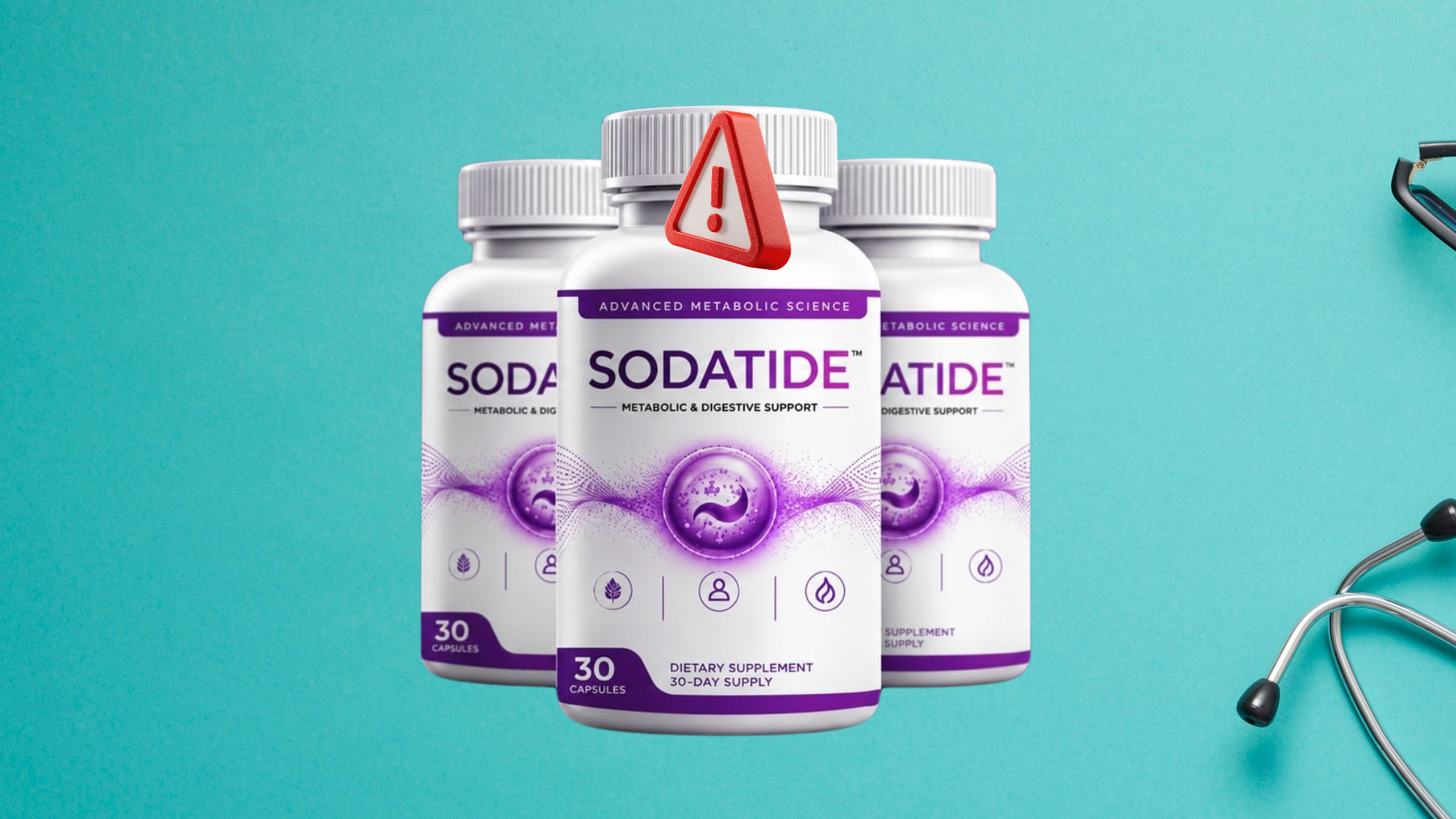
Walk down the gut health aisle and three words compete for the same shelf space: prebiotic, probiotic and synbiotic. They sound like marketing variations on a theme. They are not. They describe genuinely different things, and the difference decides whether the product you bought has any chance of doing what the box says.
SodaTide, the once-daily capsule that launched in August 2026, sits in the third category. Here is what that means in practice, and how to read any gut supplement label, including this one.
Click here to see which category SodaTide falls into, on the official page.
The three words on gut supplement labels, and which one SodaTide is
You can check SodaTide's Supplement Facts panel here. A probiotic supplies live beneficial bacteria. You are adding organisms to the community already living in your gut.
A prebiotic supplies food for those organisms. It contains no bacteria at all. It is fermentable fiber that beneficial species break down and use.
A synbiotic supplies both in the same dose, with the substrate chosen to suit the organisms travelling alongside it.
SodaTide is a synbiotic. Each capsule carries two prebiotic fibers, chicory root inulin and potato resistant starch, plus a three-strain probiotic blend of Akkermansia muciniphila, Bifidobacterium infantis and Clostridium butyricum. It is made in the United States in an FDA-registered facility, the capsule is 100% vegetarian, and the formula is lactose-free.
What a prebiotic actually does, and which ones SodaTide uses
Open the official page here to see both SodaTide fibers with their amounts. Prebiotic fiber has one defining property: it survives the stomach and small intestine and arrives in the colon still intact, where bacteria ferment it.
Chicory root inulin, the first fiber in SodaTide, is a fructan extracted from the root of Cichorium intybus. It is also selective. Bifidobacteria use it preferentially, which researchers describe as a bifidogenic effect. In 2015 the European Food Safety Authority issued a scientific opinion concluding that native chicory inulin supports normal bowel function by increasing stool frequency.
Potato resistant starch, the second, is starch that digestive enzymes cannot break down. It ferments more slowly than inulin and further along the colon, producing butyrate, the short-chain fatty acid that the cells lining the colon use as their main fuel. A controlled study in the American Journal of Clinical Nutrition in 2005 found that resistant starch supplementation improved insulin sensitivity in healthy adults.
Two fibers, two fermentation speeds, two stretches of gut fed rather than one.
What a probiotic actually does, and which strains SodaTide carries
Here is where SodaTide names all three of its strains. Probiotic organisms are judged by what they do, not by how many genus names appear on a label.
Akkermansia muciniphila is the headline strain and the least ordinary. First described by Dutch researchers in 2004, it lives inside the mucus layer that coats the intestinal wall rather than in the open interior of the gut. A 2019 study in Nature Medicine supplemented overweight and obese adult volunteers with it daily for three months and reported improved insulin sensitivity and lower total cholesterol against placebo.
Bifidobacterium infantis is a carbohydrate specialist, among the first organisms to colonize the human gut in infancy, and unusually capable at breaking down complex carbohydrates.
Clostridium butyricum is a natural butyrate producer that has been used in probiotic preparations in Japan for decades. It forms protective spores, which help it survive stomach acid on the way down.
Why a synbiotic like SodaTide is designed differently
See how SodaTide combines the two halves in one capsule here. The logic is simple once stated. A probiotic alone delivers organisms into an environment that may have nothing for them to eat. A prebiotic alone feeds whatever happens to be living there, helpful or otherwise. A synbiotic delivers the organisms and their preferred fuel together.
"The breakthrough wasn't one magical ingredient," says Dr. Ethan Caldwell, MD, PhD, the Boston physician who formulated SodaTide and whose work spans endocrinology, metabolism and gut microbiome research. "It was understanding that beneficial bacteria need the right environment and the right nutrition to thrive. That is why SodaTide was built as a system: prebiotics, resistant starch and probiotics working together rather than relying on one trendy ingredient."
The cross-feeding chain inside SodaTide
There is a second layer to the design that most labels never explain.
When Bifidobacterium infantis ferments inulin, it produces acetate and lactate. Those compounds are not waste. Butyrate-producing organisms, including Clostridium butyricum, take them up and convert them onward into butyrate. Microbiologists call this cross-feeding, and it is one of the organizing principles of a functioning gut community: one organism's output is the next one's input.
Butyrate then feeds the cells of the colon lining, supporting the barrier. Meanwhile Akkermansia muciniphila works in the mucus layer of that same barrier from the other direction.
Fiber in, acetate and lactate across, butyrate out, barrier maintained. That is SodaTide read as a system rather than an ingredient list.
What to check on any gut supplement label, including SodaTide's
Four things are worth looking for before buying anything in this category.
Are the fibers named with amounts? SodaTide prints chicory root inulin and potato resistant starch individually with their milligram amounts and botanical sources rather than folding them into an unnamed blend.
Are the strains identified? All three of SodaTide's are named on the panel.
Does it ask to be refrigerated? SodaTide does, after opening. A product that asks for cool storage is telling you there is something alive inside worth protecting. Heat, light and moisture all reduce how many organisms survive to the moment you swallow the capsule.
Is there a real guarantee? Every SodaTide order carries a 60-day money-back guarantee from the date of purchase with no conditions attached.
What SodaTide customers report
"I struggled with excess weight for years, which really affected my self-esteem," reads a verified-purchase review published by SodaTide from Michael Thompson of Houston, Texas. "After using SodaTide for 3 months, I am now able to lose weight and keep my body in shape. It has revitalized my life and given me a new confidence."
The phrase worth noticing is the second one. Maintenance is the harder half of the problem, and an approach built on the gut environment rather than on a stimulant is aimed squarely at it. Individual results vary, which is what the guarantee window is there to cover.
Where the synbiotic idea behind SodaTide came from
The category is newer than the shelf space suggests.
Probiotics reached mainstream shelves first, and for years the assumption was that adding organisms was enough. Results were inconsistent, and one reason became clear over time: an organism arriving in a gut with no suitable food source rarely establishes itself. Prebiotic fiber products emerged separately, feeding whatever community already existed.
Combining the two was the obvious next step, and the term synbiotic was coined for formulas that pair organisms with the substrate those organisms use. The research base has been building since. A 2024 systematic review and meta-analysis in Obesity Reviews pooled randomized controlled trials of probiotic and synbiotic supplementation in adults and reported reductions in body weight, body mass index and waist circumference against controls, and an umbrella review published the same year in Frontiers in Endocrinology found the same direction across prebiotic, probiotic and synbiotic approaches.
The effects described there are moderate rather than dramatic, and they sit alongside ordinary eating and activity rather than replacing them. That is also how SodaTide is positioned.
Questions buyers ask about the SodaTide formula
Is a synbiotic better than taking a prebiotic and a probiotic separately? The advantage is matching. Buying separately gives no guarantee that the fiber you chose is one the strains you chose can actually use, and it means two products, two prices and two expiry dates.
Do the strains survive the stomach? Clostridium butyricum forms protective spores that help it survive stomach acid, and Akkermansia muciniphila colonizes the mucus layer rather than passing through the open gut.
What does the fiber do on its own? It feeds the beneficial species already living in the gut, which is useful regardless of what arrives alongside it.
Why one capsule rather than a scoop of powder? Convenience is the main reason. A once-daily capsule taken at the same time each morning is a routine most people can actually keep, and consistency matters more here than dose size.
How to take SodaTide, and where it is sold
One capsule each morning with an 8-ounce glass of water, ideally before a meal. Refrigerate the bottle after opening. Some extra gas in the first week or two is normal while the gut adjusts to the new fiber supply. There is no caffeine or stimulant of any kind in the formula, so it can sit alongside morning coffee and will not affect sleep. Anyone pregnant, nursing, under 18 or managing a medical condition should show the label to their doctor first.
SodaTide is sold through its official website in three one-time packages: two bottles at $79 each, three bottles at $69 each with free US shipping, and six bottles at $49 each with free shipping, which comes to about $1.63 a day. Three- and six-bottle orders include six digital bonus guides with instant access, and no order carries a subscription.
The bottom line on reading a label like SodaTide's
Prebiotic, probiotic, synbiotic. Three words, three genuinely different products, and only one of them addresses both halves of the problem at once.
SodaTide is the third kind: two named fibers with published amounts, three named strains with research behind them, and a design built around what those organisms actually need to establish themselves. Whatever you end up buying in this aisle, that is the standard worth holding it to.
Sources
EFSA Panel on Dietetic Products, Nutrition and Allergies. Scientific opinion on native chicory inulin and maintenance of normal defecation. EFSA Journal, 2015.
Robertson MD, et al. "Insulin-sensitizing effects of dietary resistant starch and effects on skeletal muscle and adipose tissue metabolism." American Journal of Clinical Nutrition, 2005.
Derrien M, et al. "Akkermansia muciniphila gen. nov., sp. nov., a human intestinal mucin-degrading bacterium." International Journal of Systematic and Evolutionary Microbiology, 2004.
Depommier C, et al. "Supplementation with Akkermansia muciniphila in overweight and obese human volunteers: a proof-of-concept exploratory study." Nature Medicine, 2019.
Dao MC, et al. "Akkermansia muciniphila and improved metabolic health during a dietary intervention in obesity." Gut, 2016.